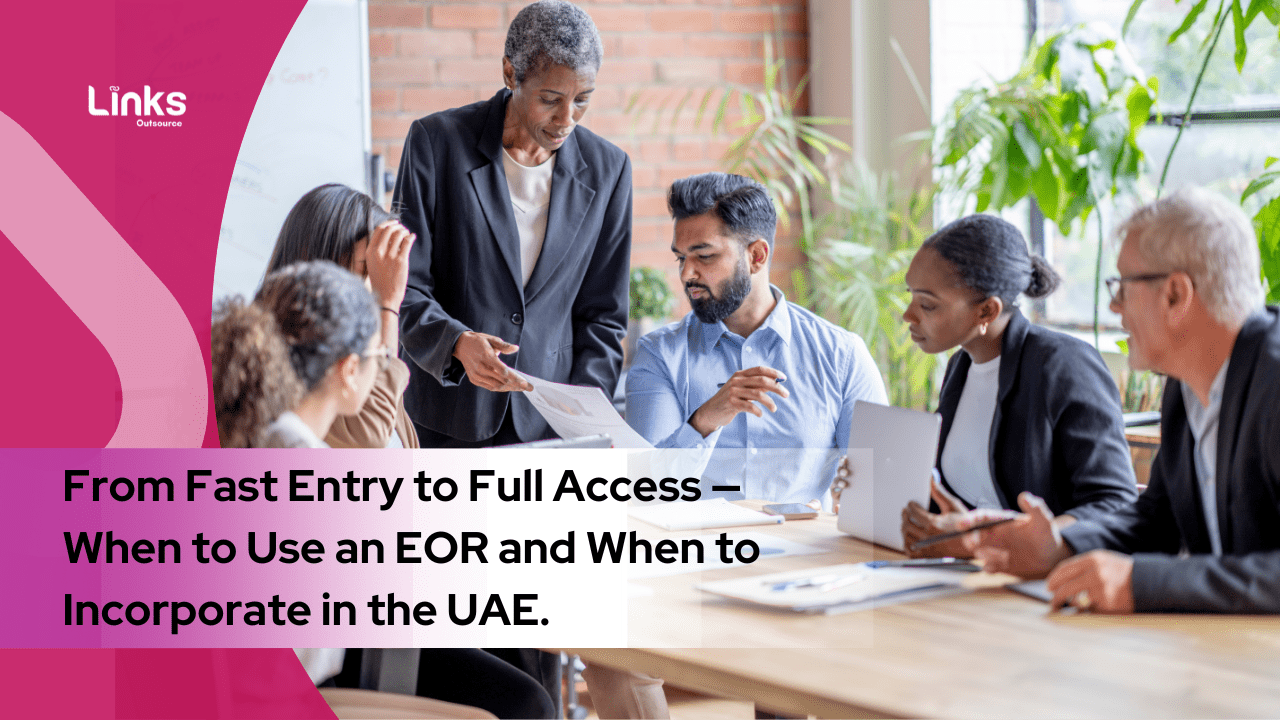
When to use an EOR in the UAE is a crucial decision for foreign investors and startups planning business expansion in the region. The UAE’s thriving economy, strong global connectivity, and pro-business policies make it a top destination for companies aiming to grow across the Middle East. However, determining whether to begin with an Employer of Record (EOR) for fast market access or to incorporate a full legal entity for long-term operations can significantly influence your business success. Understanding both options helps you balance cost, speed, and strategic growth effectively.
What Is an Employer of Record (EOR) in the UAE?
An Employer of Record (EOR) in the UAE is a third-party organization that legally employs staff on behalf of your company. It allows foreign businesses to hire employees, process payroll, and manage visas without needing a local trade license. In other words, the EOR becomes the official employer on paper, while you maintain control over your team’s day-to-day activities.
This approach offers the fastest way to hire employees in Dubai, as it removes the time-consuming process of business registration and licensing. Companies can onboard employees, start projects, and explore the market within a few days—making EOR an ideal entry solution for businesses testing the UAE market or handling short-term operations.
When to Use an Employer of Record in the UAE
Deciding when to use an Employer of Record in the UAE depends on your business stage, goals, and resource availability. Startups, SMEs, and international companies can benefit from EOR solutions under several circumstances:
- Market entry testing: If you are exploring opportunities in the UAE without wanting to invest heavily upfront, EOR provides a low-risk, cost-effective start.
- Short-term or project-based hiring: Businesses managing limited contracts or temporary projects can hire employees legally through an EOR without full incorporation.
- Remote workforce management: If your team operates remotely, the EOR handles all administrative and legal aspects, ensuring compliance.
- Speed-focused expansion: When time is critical, EOR allows you to hire and operate within days, not months.
- Budget limitations: Without trade license costs or visa deposits, an EOR is the most affordable and efficient hiring route.
This makes EOR the best hiring solution for startups entering the UAE market, enabling them to build a local presence quickly and legally while maintaining full operational flexibility.
Benefits of Using an EOR for Business Growth
Working with an EOR provides several strategic advantages:
- Quick market access: You can establish your operations and hire staff almost immediately.
- Compliance management: The EOR ensures adherence to UAE labor, immigration, and tax laws.
- No need for local sponsorship: You can legally operate without a physical office or local shareholder.
- Cost efficiency: No trade license or registration fees are required, minimizing your initial expenses.
- Risk reduction: The EOR assumes responsibility for all employment-related compliance matters.
These benefits make the EOR route ideal for agile, fast-scaling businesses seeking rapid UAE entry with minimal administrative overhead.
When Should You Incorporate Your Company in Dubai?
While EOR offers flexibility and speed, businesses planning to stay in the UAE long term should eventually consider incorporation. Understanding when you should incorporate your company in Dubai helps you identify the right moment to transition from temporary to permanent operations.
You should incorporate when:
- You’re ready for long-term expansion: If your business model proves successful, incorporation allows you to solidify your market presence.
- You need local trading access: Only registered companies can issue invoices and participate in government or corporate tenders.
- You plan to build your brand: Having a trade license strengthens your reputation and visibility in the UAE market.
- You’re scaling operations: Incorporation is more cost-effective when managing large teams or ongoing projects.
- You need control: A licensed entity allows full ownership, decision-making authority, and direct market access.
The UAE’s recent reforms now allow 100% foreign ownership in most sectors, making incorporation even more attractive for international entrepreneurs.
Combining Both Models Strategically
The smartest strategy for many businesses is to start fast with an EOR, then transition to full incorporation once the business grows. Initially, using an EOR gives you quick market access, compliance coverage, and low setup costs. Once you establish a steady client base or workforce, you can smoothly transfer employees to your new trade license under your company name.
This hybrid approach provides both fast entry and full access, helping you manage risk while scaling sustainably in the UAE.
EOR vs. Incorporation: A Quick Comparison
| Criteria | Employer of Record (EOR) | Company Incorporation |
|---|---|---|
| Setup Time | 3–5 days | 2–6 weeks |
| Initial Cost | Low | High (license + office) |
| Market Access | Limited | Full |
| Compliance | Managed by EOR | Managed by your business |
| Scalability | Best for small teams or testing | Best for long-term growth |
| Ideal For | Startups, remote teams, pilot projects | Established, growing firms |
This comparison shows how EOR is ideal for speed and affordability, while incorporation ensures independence and full market potential.
Final Thoughts
Choosing between an EOR and company incorporation depends on your timeline, budget, and business goals. If your immediate goal is fast hiring and operational entry, the fastest way to hire employees in Dubai is through an EOR model. It’s ideal for startups and companies testing the market before committing to a full setup.
However, if your vision is long-term growth, client engagement, and brand building, incorporating your company in Dubai provides greater freedom, control, and access to opportunities.
By understanding when to use an Employer of Record in the UAE and when you should incorporate your company in Dubai, you can design a balanced expansion plan that combines flexibility, compliance, and scalability—ensuring your success in one of the world’s most dynamic business hubs.